What Is Actually Inside the Vigorus 570 mg Proprietary Blend?
The short version
Vigorus discloses a 570 mg proprietary blend containing L-citrulline, L-carnitine, pine bark extract, maca root extract, grape skin extract and saffron stigmas extract, in that order and with no individual amounts. Because US labelling rules require descending order by weight, citrulline is the largest share and saffron the smallest — but 570 mg is far below the gram-scale doses used in the citrulline and carnitine trials, so those two cannot both be present at researched amounts.
- Descending order is a ranking, not a dose: it fixes the order of the six and nothing else.
- Citrulline and carnitine are studied in grams; the whole blend is 570 mg, so the arithmetic is decisive before you argue about anything else.
- Pine bark, grape skin and saffron are studied at milligram doses, so those three could genuinely fit — the label just does not say whether they do.
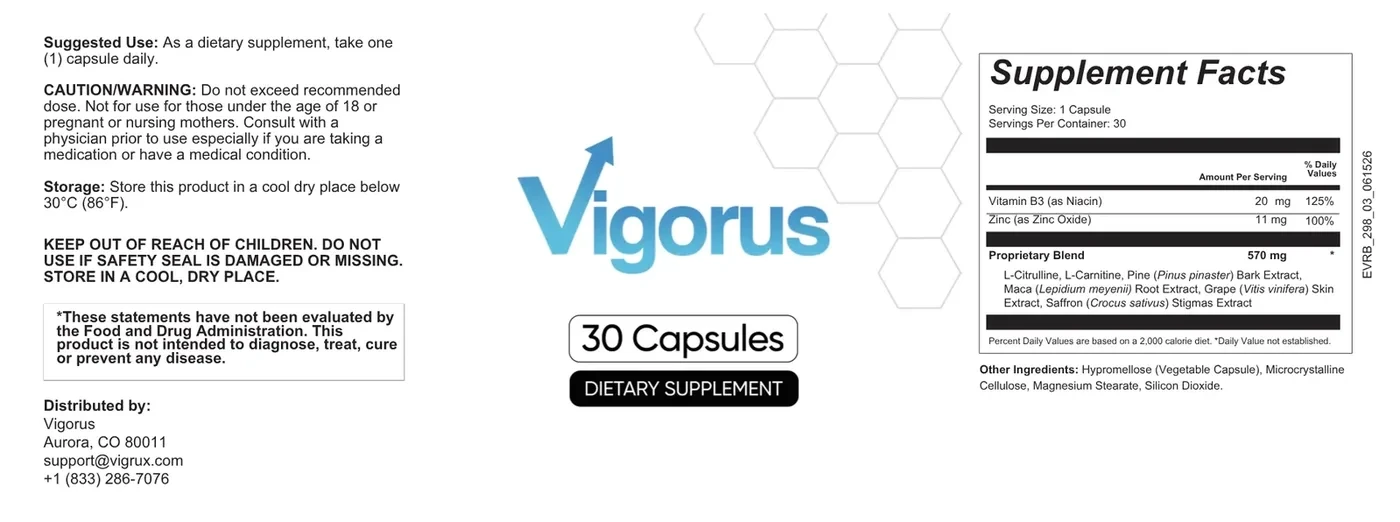
The label does two different things in the space of four lines
Read the Vigorus panel from the top and it behaves like a well-made label. Serving size: one capsule. Servings per container: thirty. Vitamin B3 (as Niacin), 20 mg, 125% of the Daily Value. Zinc (as Zinc Oxide), 11 mg, 100%. Exact amounts, named forms, Daily Values calculated. Nothing is hidden and nothing needs interpreting.
Then comes the fifth line, and the label stops doing that. Proprietary Blend, 570 mg, followed by six ingredient names run together as a single sentence: L-citrulline, L-carnitine, pine (Pinus pinaster) bark extract, maca (Lepidium meyenii) root extract, grape (Vitis vinifera) skin extract, saffron (Crocus sativus) stigmas extract. Six ingredients, one number, no split.
Both halves of that panel are legal and normal. It is worth being clear about that, because the interesting question is not whether the manufacturer has done something wrong — it has not — but what the second half actually leaves you able to work out.
What descending order does and does not give you
FDA labelling rules let a manufacturer declare a blend as a single total, provided the components are listed in descending order by weight. That rule is doing real work here, and it is the reason this analysis can say anything at all.
It fixes the ranking. L-citrulline is the largest single share of the 570 mg; saffron extract is the smallest. Carnitine is second, pine bark third, maca fourth, grape skin fifth. That ordering is a statement of fact by the manufacturer, not a guess.
What it does not fix is any quantity. Six ingredients in descending order inside 570 mg is consistent with a formula that is almost entirely citrulline and five sprinkles, and equally consistent with six roughly even portions. Those are very different products and the label cannot tell them apart. A ranking without amounts constrains the possibilities; it does not identify one.
Where the arithmetic settles the argument
For two of the six, though, you do not need the split — the total already rules things out.
L-citrulline is the ingredient this category is built on, for a good physiological reason: the body converts it to arginine, arginine is the substrate for nitric oxide, and nitric oxide relaxes the smooth muscle in blood-vessel walls. It is also an ingredient whose human research is conducted at doses measured in grams, not fractions of a gram. Whatever share of 570 mg citrulline takes, it is a different order of magnitude from the amounts those trials used.
L-carnitine has the same problem twice over. The trials that made carnitine interesting in men's health used gram-scale doses, and they mostly used specific esters — propionyl- and acetyl-L-carnitine — rather than the plain L-carnitine this label prints. Two of the six ingredients are therefore, on the arithmetic alone, present at amounts well below their studied range, and they are the two the formula leads with.
This is not an accusation of dishonesty. It is what happens when six ingredients have to share one capsule: a capsule has a physical volume, amino acids are bulky, and something has to give. It is simply worth knowing before you read the ingredient list as a promise.
The three that could genuinely fit
The other side of the same arithmetic is more encouraging, and it rarely gets said.
Pine bark extract — French maritime pine bark, the procyanidin source — is studied at doses in the low hundreds of milligrams. That fits inside 570 mg comfortably. Grape skin extract, the polyphenol ingredient, is typically dosed in the hundreds of milligrams too. And saffron stigmas extract is studied at genuine milligram doses, small enough that a researched amount would barely register against the total.
So three of the six could plausibly be present at amounts the literature would recognise. Whether they are is exactly what the label does not say — and saffron, listed last, is also the ingredient most often added in a token quantity precisely because its name carries weight on a list. The honest position is that the blend could be a sensible botanical formula with two undersized amino acids in front of it, or it could be mostly filler-grade citrulline with five garnishes. Both are consistent with everything published.
Maca is the one that depends on a missing word
Maca sits fourth and deserves its own paragraph because its answer turns on a detail the label omits. The clinical work on maca generally uses whole powdered root in gram quantities. The label says extract, and an extract can be many times more concentrated than the root it came from — but only if you know the ratio or the standardisation, and Vigorus prints neither. Without that, there is no conversion from what is in the capsule to what was studied. The ingredient name alone carries no dose information at all.
The two disclosed lines, briefly
Above the blend, the panel is straightforward. Zinc at 11 mg is a full Daily Value, and zinc is the one ingredient in this product with a formal regulatory footing: European authorities have authorised the claim that zinc contributes to the maintenance of normal testosterone levels in the blood. The caveat is the form. The label specifies zinc oxide, the cheapest common zinc salt and the one comparison studies have repeatedly found less well absorbed than citrate, gluconate or picolinate. Eleven milligrams on the label is a ceiling, not a delivered dose.
Niacin at 20 mg is modest and uncontroversial, with one loose end: the label writes the form as “as Niacin”, which covers both nicotinic acid, the version that can cause a harmless warm flush, and niacinamide, which does not. At this amount a flush is unlikely either way, but the panel does not let you rule it out.
What to do with all of this
Vigorus is not an opaque product. It publishes a real panel, it prints its vitamin and its mineral exactly, it names every ingredient in the blend, and it orders them honestly. Against the baseline of its category, that is above average, and it should be said plainly rather than grudgingly.
It is also not a product you can evaluate, because the line that would let you evaluate it is the one line left blank. Six ingredients, one total, and no way to compare any of them with the research that makes them worth including.
There is a single question that closes most of that gap, and it costs an email: how many milligrams of L-citrulline are in one capsule? It is the first-listed ingredient, so its answer bounds the other five. A manufacturer that knows its own formula can reply in one line — and if the reply does not come, that is information too, particularly if you were about to buy six bottles.
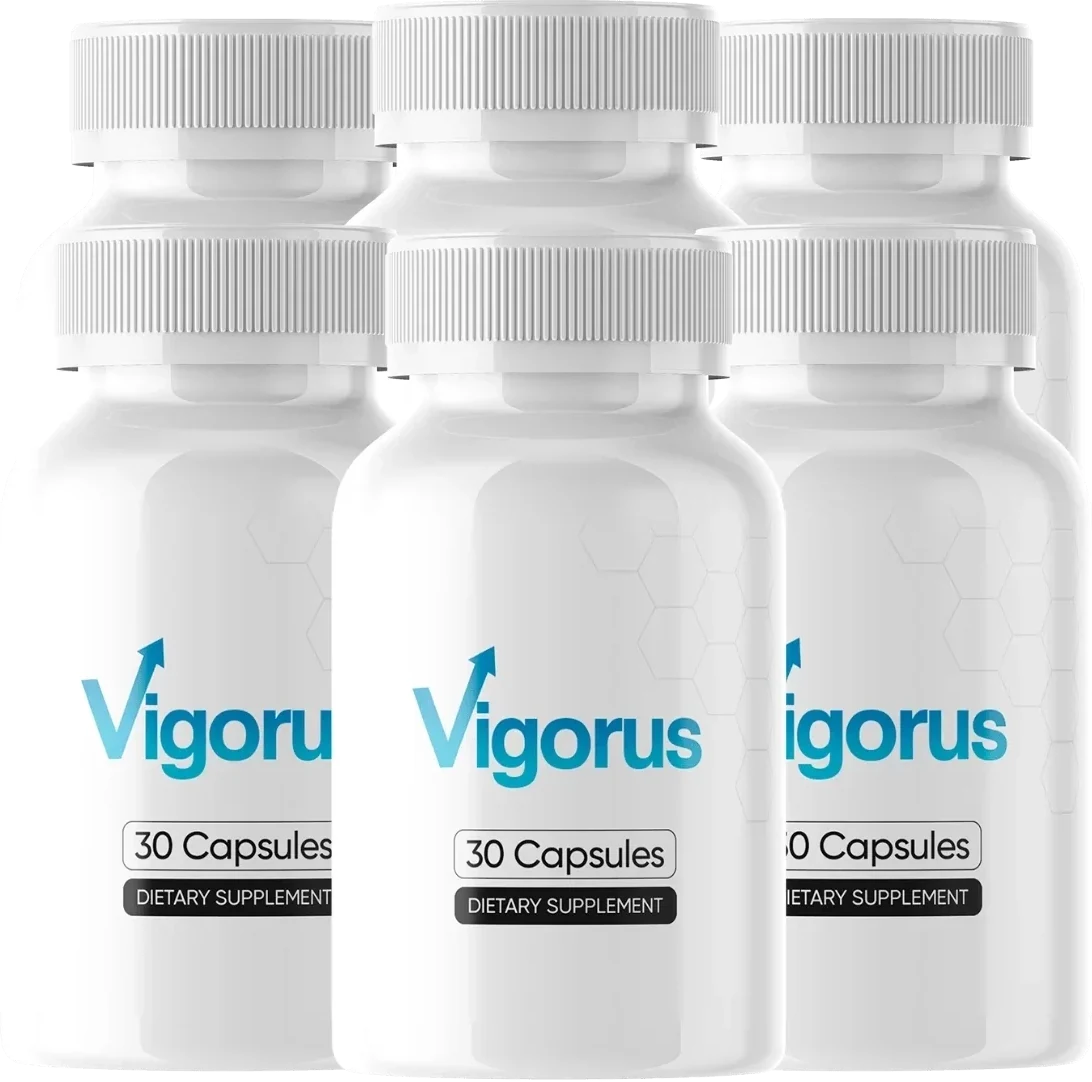
The bottle this panel belongs to
One capsule daily, 30 per bottle, with the niacin and zinc amounts printed and the blend split withheld.
Order NowFrequently asked questions
Does descending order tell me the doses?
No, only the ranking. US labelling rules require the components of a proprietary blend to be listed in descending order by weight, so on the Vigorus label L-citrulline is the largest share of the 570 mg and saffron extract the smallest. That constrains the possibilities but fixes no number: the largest share could be most of the blend or barely more than a sixth of it.
Is a proprietary blend allowed?
Yes. FDA labelling regulations permit a manufacturer to declare a blend by its total weight and list the components without individual amounts, provided the components appear in descending order by weight. It is legal, it is common, and it is also the single biggest obstacle to comparing a product with the research on its ingredients.
Which of the six could realistically be at a studied dose?
Pine bark extract, grape skin extract and saffron extract are the plausible ones, because their research doses are measured in milligrams rather than grams and would fit inside 570 mg with room to spare. L-citrulline, L-carnitine and whole-root maca are studied at gram-scale doses, which the blend total cannot accommodate for more than one of them at most.
What should I ask the seller before buying?
How many milligrams of L-citrulline are in one capsule. It is the first-listed ingredient, the one the formula is built around, and the one whose answer tells you most about the rest. A store that knows its own formula can answer in a sentence.
References
- FDA — Dietary Supplement Labeling Guide, Chapter IV: Nutrition Labeling
- FDA — Dietary Supplements: What You Need to Know
- NIH Office of Dietary Supplements — Zinc, Health Professional Fact Sheet
- NIH Office of Dietary Supplements — Niacin, Health Professional Fact Sheet
- NIH Office of Dietary Supplements — Dietary Supplements for Exercise and Athletic Performance
- EFSA — Scientific Opinion on the substantiation of health claims related to zinc